



Cluster Feeding Explained: What It Looks Like and How to Cope
Newborn life already has a certain "what day is it?" quality. Then cluster feeding shows up and suddenly your baby seems to want to eat every 20 minutes, your water bottle is empty, your snacks are gone, and someone has definitely lost track of which side was last.
First: deep breath. Cluster feeding can feel alarming, but it is often a normal newborn pattern. It usually means your baby wants several feeds close together over a stretch of time, instead of spacing feeds out neatly like the internet promised. Cleveland Clinic describes cluster feeding as several short feeds spaced closer together than expected, and notes that it can be normal in the first few days of life and at certain times of day, such as evenings.
That said, "normal" does not mean "ignore everything." The trick is knowing what cluster feeding can look like, what red flags deserve a call, and what is actually worth tracking while you ride it out.
This article is general information, not medical advice, and is not written or reviewed by a medical professional. It is not a substitute for professional medical care. Every baby is different, and Milk Drunk is not a medical device. Always consult your pediatrician or a qualified healthcare provider about your child's health, feeding, or care, and seek medical care right away if you are worried.
What is cluster feeding?
Cluster feeding is when your baby feeds more frequently than usual over a period of time. Instead of a feed, a nap, and a peaceful little stretch, it may look more like:
Feed. Doze. Root. Feed again. Pause. Fuss. Feed again. Repeat.
It often happens in the late afternoon or evening, but it can happen at other times too. The NHS describes cluster feeding as a period when babies want to feed even more frequently, sometimes constantly, and says it is common in the first 3 to 4 months. The NHS also notes that formula-fed babies can cluster feed too, while reminding parents not to overfeed and to watch for fullness cues.
Cluster feeding is not your baby being dramatic. Well, okay, newborns are a little dramatic. But biologically, there are real reasons this can happen: tiny stomachs, comfort needs, growth spurts, evening fussiness, and the way milk supply responds to frequent feeding. Cleveland Clinic notes that normal reasons can include small tummy size, comfort, developmental changes, and lower evening prolactin levels.
When does cluster feeding usually show up?
Cluster feeding can happen right from the newborn days. It is especially common during stretches when your baby seems to be growing, waking up to the world, or wanting extra comfort.
Many newborns also feed much more often than adults expect. The CDC lists frequent breastfeeding (8 to 12 times in 24 hours) as one sign that a baby is getting enough to eat, along with swallowing during feeds, seeming content afterward, steady weight gain, and enough wet and dirty diapers. HealthyChildren.org, from the American Academy of Pediatrics, says breastfed newborns often nurse every 2 hours from the start of one feed to the start of the next, making 10 to 12 sessions in 24 hours normal. Bottle-fed newborns often eat every 2 to 3 hours, with 8 feeds in 24 hours generally recommended as a minimum.
So yes, it can feel like your baby is eating all the time because, in a very real newborn way, they kind of are. For a week-by-week picture of how feeds typically space out across the first two months, see our newborn feeding schedule by week.
Cluster feeding vs. red flags
Cluster feeding can be normal. But a baby who is not getting enough milk, is sick, or is too sleepy to feed well may also want to feed constantly, or may not feed enough.
Call your pediatrician or seek medical advice promptly if you notice any of these:
- Fewer wet or dirty diapers than expected
- Baby is very sleepy, floppy, hard to wake, or much less alert than usual
- Baby misses two or more feeds in a row or is feeding poorly
- Signs of dehydration, such as fewer wet diapers, dry mouth, fewer tears, or a sunken soft spot
- Fever, especially in a baby 3 months or younger
- Baby is still cluster feeding around the clock after the first week
- You cannot hear or see swallowing, latch is painful, or baby keeps coming off the breast
The CDC says signs a baby may not be getting enough include breastfeeding fewer than 8 times per day, not hearing or seeing swallowing, latch trouble, continued weight loss after day 5, yellow-looking skin, or fewer than 3 poops and fewer than 6 pees per day by 5 days old. Mayo Clinic advises calling if a baby misses two or more feedings, eats poorly, is sleepier than usual or hard to awaken, has fewer wet diapers, or shows signs of dehydration.
For fever: HealthyChildren.org says a rectal temperature of 100.4°F / 38°C or higher is considered a fever, and if your baby is 3 months or younger with that temperature, you should call your pediatrician immediately, even if there are no other symptoms.
What cluster feeding can look like over 24 hours
This is not a schedule to copy. It is just an example of how a normal-ish day can look wildly unscheduled.
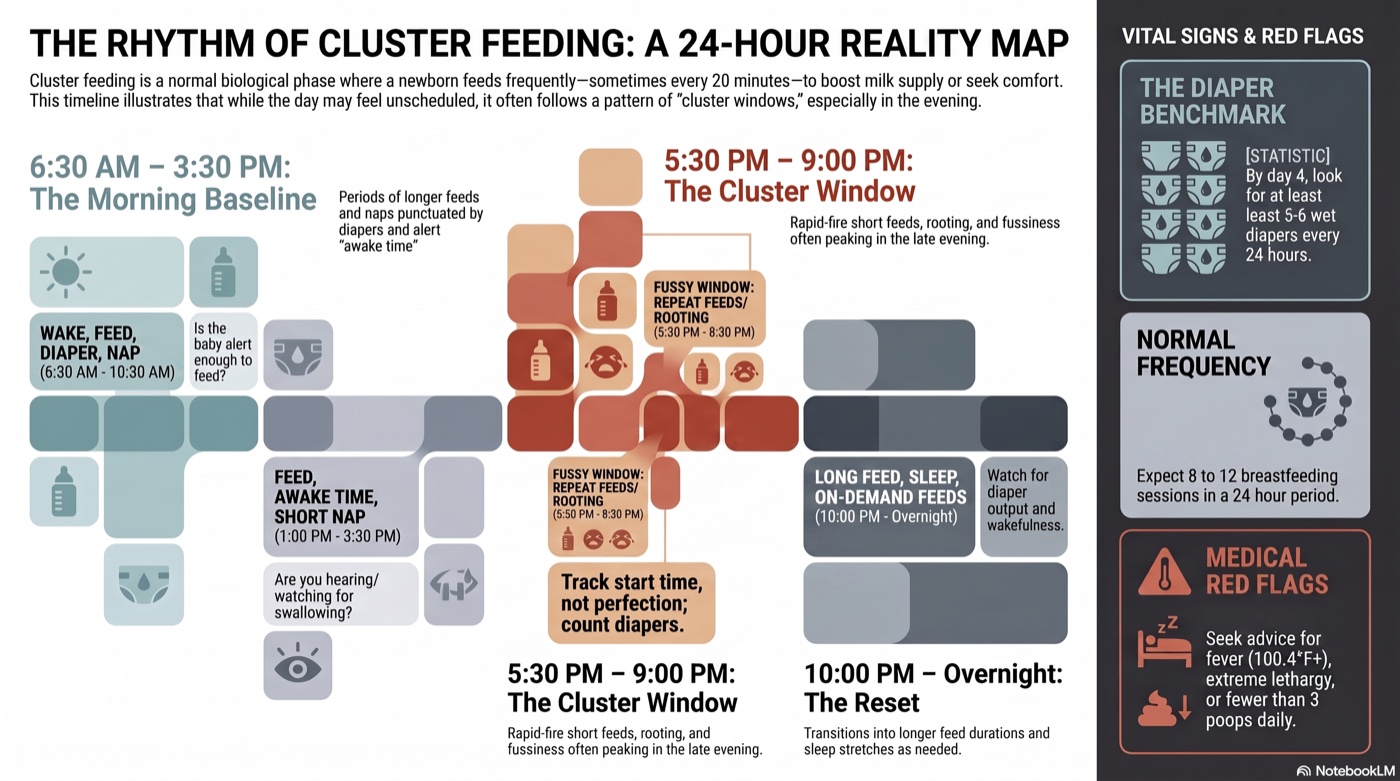
| Time | What might happen | What to notice |
|---|---|---|
| 6:30 AM | Feed after waking | Was baby alert enough to feed? |
| 8:00 AM | Short feed, diaper | Wet/dirty diaper count starts building |
| 10:30 AM | Longer feed, nap | Listen/watch for swallowing |
| 1:00 PM | Feed, awake time, diaper | Baby seems content or still frantic? |
| 3:30 PM | Feed, short nap | Normal newborn rhythm may be uneven |
| 5:30 PM | Feed, fuss, feed again | Cluster window may begin |
| 6:15 PM | Another short feed | Track start time, not perfection |
| 7:00 PM | Diaper, comfort, feed again | Count diapers and alertness |
| 8:30 PM | Feed, doze, root again | This can feel endless, but it often passes |
| 10:00 PM | Longer feed, sleep stretch | Parent handoff time if possible |
| Overnight | Feeds as needed | Watch diaper output and wakefulness |
The most important takeaway is not that your baby should follow this. They will not. They have not read the chart. The point is that cluster feeding often looks like a messy pattern when you are inside it, but logging a few basics can help you see whether the day is still moving in a healthy direction.
Tracking this by memory is unfair to your sleep-deprived brain. Milk Drunk lets you log feeds, diapers, and alertness in one tap, so "when did she last eat?" has an answer.
How to cope when your baby wants to eat constantly
Keep hydration and snacks within arm's reach
Cluster feeding is not the moment for heroic self-denial. Set up a tiny feeding station: water bottle, one-handed snacks, burp cloths, nipple cream if needed, phone charger, and something calming to read or listen to. Not glamorous. Very effective.
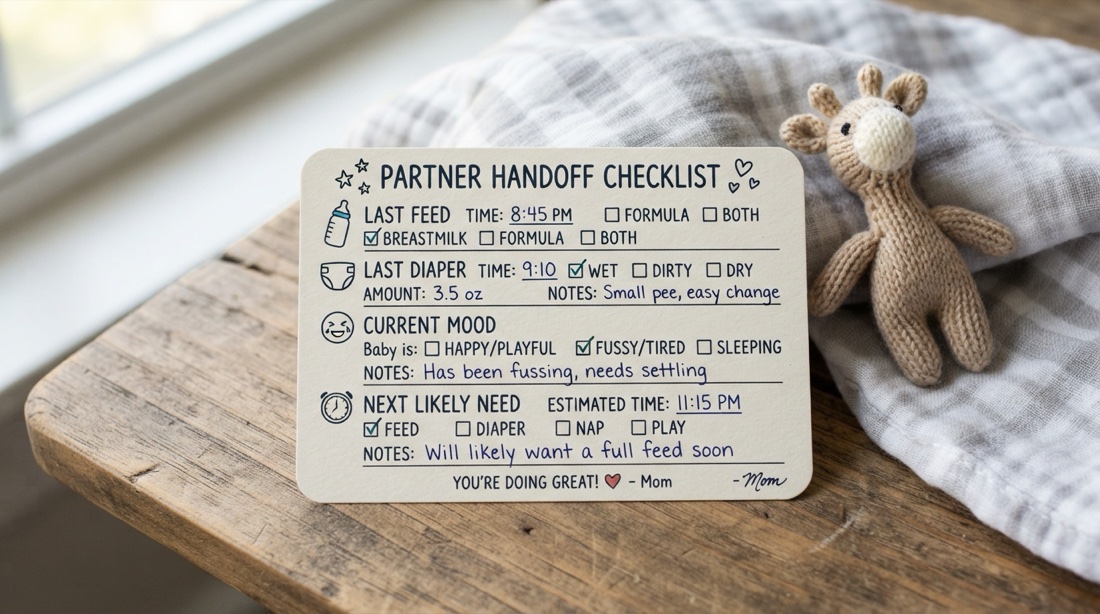
Use the partner handoff
A partner may not be able to do the feeding, depending on how your baby is fed, but they can do a lot: diaper change, burping, bottle prep, snack refill, water refill, baby soothing, pump part washing, and the sacred duty of saying, "You're doing a good job."
If bottle feeding or combo feeding is part of your plan, this is where shared tracking helps. One parent should not have to be the household memory.
Protect your nipples
Frequent feeding can make soreness worse, especially if latch is not great. Pain, cracking, bleeding, or a baby who keeps sliding off the breast can be signs to ask for help. The CDC lists cracked or bleeding nipples, pain, and baby coming off the breast as signs of a bad latch, and recommends getting help from a healthcare or lactation support provider if you are worried about latch or milk supply.
A lactation consultant is not only for emergencies. They are also for the "I think this is working but I would love for it to hurt less" stage.
Watch fullness cues with bottles
Bottle-fed babies can cluster feed, but bottles can also make it easier to overfeed because milk flows differently. The NHS recommends watching for cues that baby needs a break or is full, such as stopping sucking, turning their head away, pushing the bottle away, spilling milk, or falling asleep at the end of the feed. This is a good place to go slow, pause often, and let baby lead.
Call sooner when your gut says something is off
You are not bothering the pediatrician. Newborns are tiny mysteries with very loud opinions. If the pattern feels extreme, baby is not acting right, diaper output is low, or you are worried about feeding, call. Cleveland Clinic specifically notes that if a baby older than 1 week is cluster feeding around the clock, it is worth calling a pediatrician because it could be a sign they are not getting enough milk.
What to track during cluster feeding
You do not need a perfect log. You need a useful one. Track the things that help you answer the big questions: When did baby last eat? Are feeds happening often enough? Are diapers keeping up? Is baby alert enough? Is this getting better, worse, or just temporarily chaotic?
A simple cluster-feeding log can include:
- Feed start time
- Feed length
- Breast side, bottle ounces, or formula amount
- Wet diapers
- Dirty diapers
- Baby alertness: sleepy, alert, hard to wake, unusually fussy
- Notes like spit-up, latch pain, or "called pediatrician"
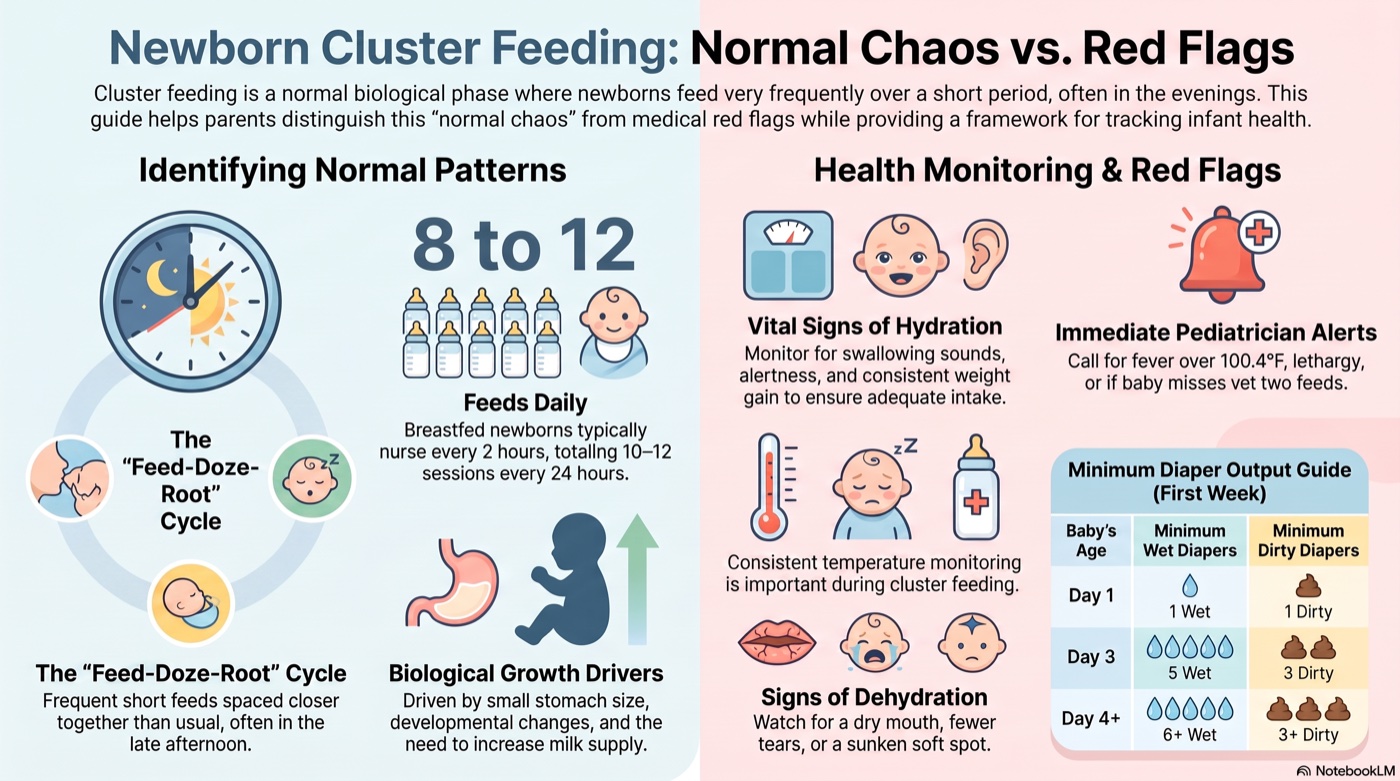
The CDC's diaper guide is especially useful in the first week. It lists minimum wet diapers as 1 on day 1, 2 on day 2, 5 on day 3, and 6 on days 4 through 7, with poop counts also tracked during those early days. HealthyChildren.org says that after the first 4 to 5 days, babies should have at least 5 to 6 wet diapers a day.
Those numbers are not meant to turn you into a spreadsheet with a heartbeat. They are there to help you spot when it is time to ask for help.
You are not trying to create a perfect schedule
This is the part worth taping to the fridge: cluster feeding is not a scheduling failure.
The goal is not to force your newborn into a tidy routine. The goal is to get through a chaotic phase with enough information to feel grounded. You want to know: baby is feeding, diapers are happening, baby is reasonably alert, and the pattern is not drifting into red-flag territory.
That is where a simple tracker can be genuinely helpful. Not because every minute of newborn life needs to become data. It does not. But because when you are tired, it is weirdly hard to remember whether the last feed was 20 minutes ago or two hours ago. It all becomes one long nursing-chair-shaped blur. Milk Drunk gives you a low-stress way to log feeds in one tap, review trends without doing mental math, and export a clean summary if your pediatrician or lactation consultant asks what has been happening.
No perfect schedule required. Just enough clarity to help you breathe.
Frequently asked questions
How long does cluster feeding last?
Individual cluster-feeding stretches often last a few hours, commonly in the evening, and then ease. As a phase, it tends to come and go around growth and development spurts across the first few months rather than lasting continuously. If your baby is cluster feeding around the clock beyond the first week, check in with your pediatrician, since Cleveland Clinic notes that can signal they are not getting enough milk.
Is cluster feeding at night normal?
Frequent evening and nighttime feeding is common, and lower evening prolactin levels are one of the normal reasons babies bunch feeds together late in the day. Normal does not mean you have to white-knuckle it alone. Trade off with a partner, and watch for the red flags above.
Is cluster feeding a sign of low milk supply?
Usually not. Frequent feeding is normal newborn behavior and actually helps build supply. The more reliable signs of intake are diaper counts, weight gain, and swallowing during feeds. If those are off, or feeding is painful, that is the time to get lactation support rather than to assume cluster feeding alone means low supply.
Can formula-fed babies cluster feed?
Yes. The NHS notes formula-fed babies can cluster feed too. With bottles it is easier to overfeed, so go slowly, pause often, and watch fullness cues: turning away, pushing the bottle away, or drifting off at the end of a feed.
Sources
- Cleveland Clinic: What Is Cluster Feeding?
- NHS: Cluster feeding
- CDC: Newborn Breastfeeding Basics
- HealthyChildren.org (AAP): How Often and How Much Should Your Baby Eat?
- Mayo Clinic: Sick baby? When to seek medical attention
- HealthyChildren.org (AAP): Fever and Your Baby