


Newborn Feeding Schedule by Week: A Realistic Guide for the First 8 Weeks
If you found yourself trying to remember the last feed, the bottle ounces, and which side you used while also functioning on broken sleep, welcome. This guide is for that exact stage of life.
Let's start with the most important thing: this is not a rigid schedule. It is a realistic week-by-week rhythm you can use as a reference point. For most healthy, full-term newborns, feeding is responsive, not perfectly timed. In other words, baby cues matter more than a color-coded spreadsheet.
Whether you are directly breastfeeding, feeding expressed milk, using formula, or doing some combination of all three, the basic question is the same: is my baby feeding often enough, acting satisfied between at least some feeds, making enough wet and dirty diapers, and gaining weight the way their clinician expects? Those markers matter more than whether Tuesday looked exactly like Monday.
This article is general information, not medical advice, and is not written or reviewed by a medical professional. It is not a substitute for professional medical care. Every baby is different, and Milk Drunk is not a medical device. Always consult your pediatrician or a qualified healthcare provider about your child's health, feeding, or care, and seek medical care right away if you are worried.
Week 1
Week 1 is not elegant. It is more like a snack bar with no closing time.
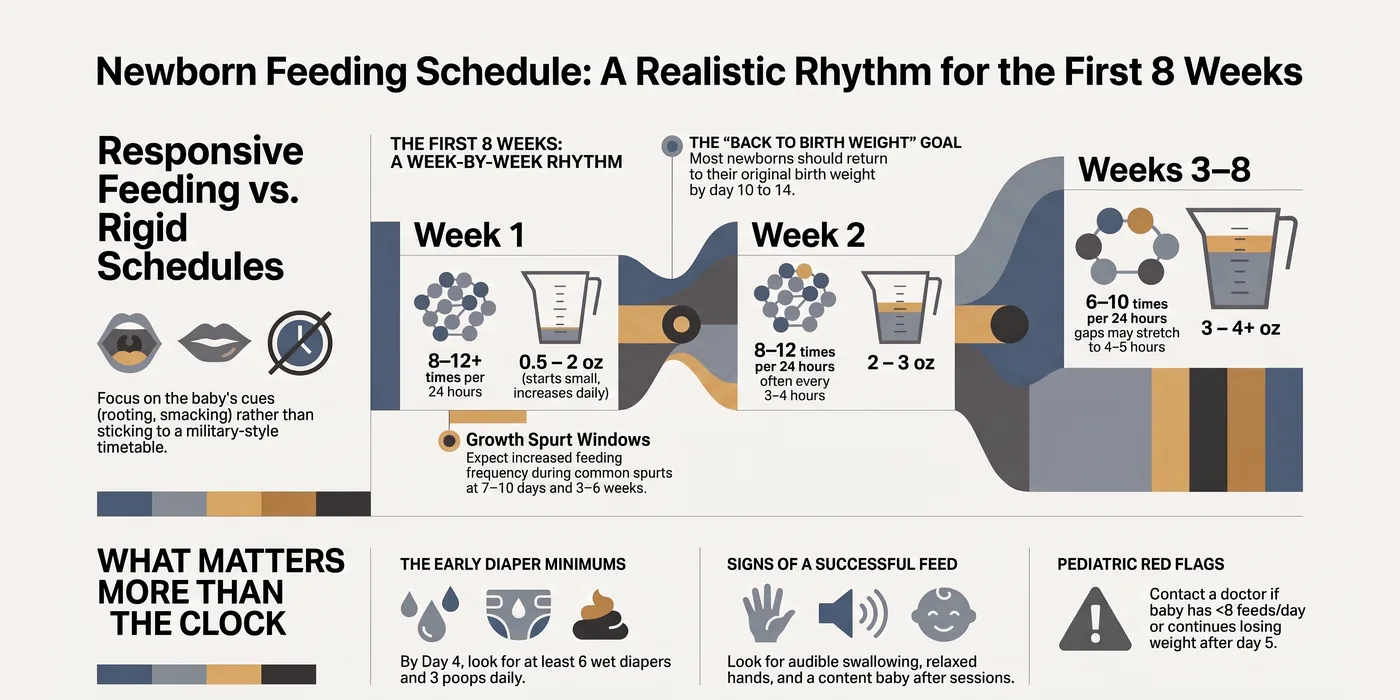
Breastfed newborns commonly feed 8 to 12 times in 24 hours, and sometimes more. The CDC says babies may want to eat as often as every 1 to 3 hours in the first few weeks, including overnight. HealthyChildren.org, from the American Academy of Pediatrics, says breastfed newborns often nurse every 2 hours from the start of one feed to the start of the next, which makes 10 to 12 sessions in 24 hours normal.
If your baby is bottle-fed, whether that bottle contains formula or expressed milk, intake is usually still small at first. HealthyChildren.org says newborns may take only about half an ounce per feeding for the first day or two, then usually move to 1 to 2 ounces per feeding. The CDC says formula-fed newborns start with 1 to 2 ounces every 2 to 3 hours, and many feed 8 to 12 times in 24 hours.
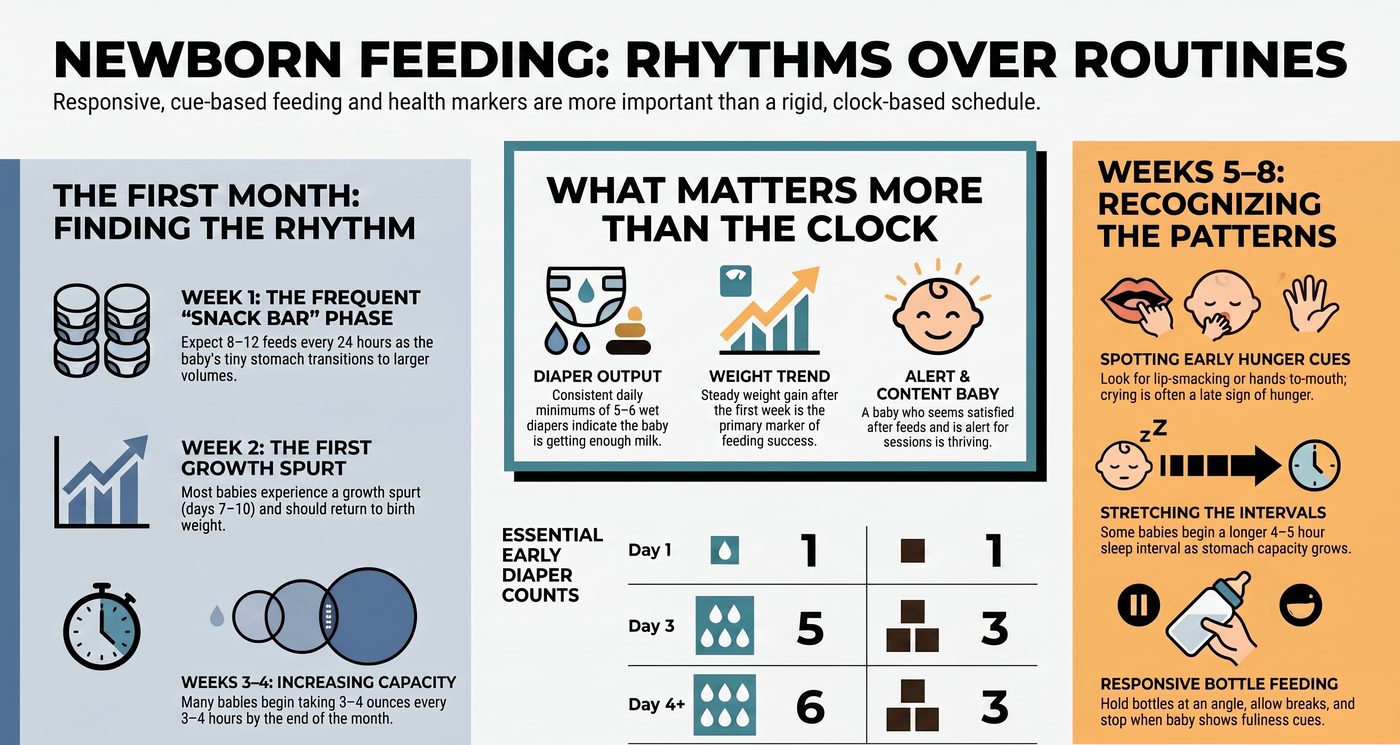
What matters most this week is not "getting on a schedule." It is seeing the basic signs build in the right direction. CDC's early diaper guide is one of the most useful reality checks: day 1 is at least 1 wet diaper and 1 poop; day 2 is 2 wets and 3 poops; day 3 is 5 wets and 3 poops; day 4 is 6 wets and 3 poops; and days 5 through 7 stay at 6 wets and 3 poops minimum.
Week 2
Week 2 often feels like you just started to get your footing and then the baby changes the rules.
That is not your imagination. HealthyChildren.org notes that growth spurts commonly happen around 7 to 10 days old. During a growth-spurt patch, babies may want to feed more often for a while, even if things had started to feel calmer.
For direct breastfeeding, this usually still means frequent feeds, often staying in that 8 to 12 times per day range. For expressed milk, the rhythm is still baby-led: offer the bottle in a responsive way, let baby pause, and stop when they show fullness cues instead of urging them to finish. The CDC says to hold the bottle at an angle, let baby take breaks, and stop when they are full even if milk is left.
If you are pumping instead of nursing at the breast, the CDC recommends pumping as often as your baby normally drinks breast milk so your body keeps getting the signal to make what baby needs.
This is also the week when weight matters more than vibes. The CDC says it is normal for breastfed babies to lose some weight in the first week, but they should be back to birth weight by day 10 to 14. HealthyChildren.org similarly says babies should start gaining steadily once they are about 5 days old and are usually back to birth weight by about 2 weeks.
Weeks 3 to 4
This is the part where some babies begin to look a little less random, and then a growth spurt barges in wearing muddy shoes.
Over the first few weeks and months, the CDC says most exclusively breastfed babies feed every 2 to 4 hours on average, though some still feed as often as every hour at times. Bottle-fed babies often begin stretching toward every 3 to 4 hours as intake per feed grows. By the end of the first month, HealthyChildren.org says many babies take at least 3 to 4 ounces per feeding, about every 3 to 4 hours.
The AAP also notes another common growth-spurt window between 3 and 6 weeks. So if your baby had one or two more predictable days and then suddenly wanted to eat like they are training for a marathon, that still fits within a normal range. And if your baby bunches several feeds close together for a stretch, especially in the evening, that pattern has a name: we cover it in our guide to cluster feeding.
For combination feeding, this is a good place to reassure without excluding. The NHS notes that mixed feeding means combining breastfeeding with bottles of expressed milk or formula, and that many families add bottles once breastfeeding feels more established. It also notes that introducing formula can affect milk supply, so gradual changes are gentler on both the parent and the feeding rhythm.
Weeks 5 to 8
By now, some families start hoping for a truly predictable rhythm. That is reasonable. It is also slightly ambitious.
Many exclusively breastfed babies still average every 2 to 4 hours, and the CDC notes that some may have a longer sleep interval of 4 to 5 hours at times. Formula-fed babies commonly stay closer to every 3 to 4 hours as the weeks go on, with bigger feeds and slightly longer gaps. So yes, spacing out can happen. But "newborn feeding schedule" still usually means a rhythm, not a neat routine. (Sleep follows the same logic; our newborn sleep schedule by week covers that side of the day.)
The biggest shift in this stretch is often less about the clock and more about parent confidence. You start to notice your baby's particular cues. Maybe they root and lip-smack before feeds. Maybe they go from "calmly interested" to "furious tiny customer" in about ninety seconds. Those early hunger cues matter, because the CDC says crying is often a late sign of hunger.
What matters more than the clock
If you only remember one box from this article, make it this one.
A reasonable newborn feeding plan is not measured by whether every feed happened at the same minute every day. It is measured by whether your baby is feeding often enough, showing hunger and fullness cues, making enough wet and dirty diapers, staying reasonably alert for feeds, and gaining weight the way their clinician expects. The CDC lists frequent feeding, visible or audible swallowing, seeming content after a feed, steady weight gain, and enough pees and poops as the big signs that things are going well.
HealthyChildren.org adds that after the first 4 to 5 days, babies should usually have at least 5 to 6 wet diapers a day. For newborn hunger cues, the CDC says to look for hands moving to the mouth and baby turning toward the breast or bottle. Fullness cues include closing the mouth and turning the head away.
A sample day you can track
This sample day is illustrative, not a prescription. It is here to show how a normal newborn day can still look busy, irregular, and completely valid.
| Time | What might happen | What to log |
|---|---|---|
| 6:00 AM | Feed | Start time, side or ounces |
| 8:15 AM | Feed again | Start time, duration or ounces |
| 10:45 AM | Feed + diaper | Wet/dirty diaper |
| 1:00 PM | Feed | Side or bottle amount |
| 3:30 PM | Feed | Start time |
| 5:45 PM | Feed | Alertness, fussiness |
| 7:15 PM | Feed | Side or ounces |
| 9:30 PM | Feed + diaper | Wet/dirty diaper |
| Overnight | 2 to 4 more feeds, depending on age and baby | Keep it simple: time, amount, diapers |
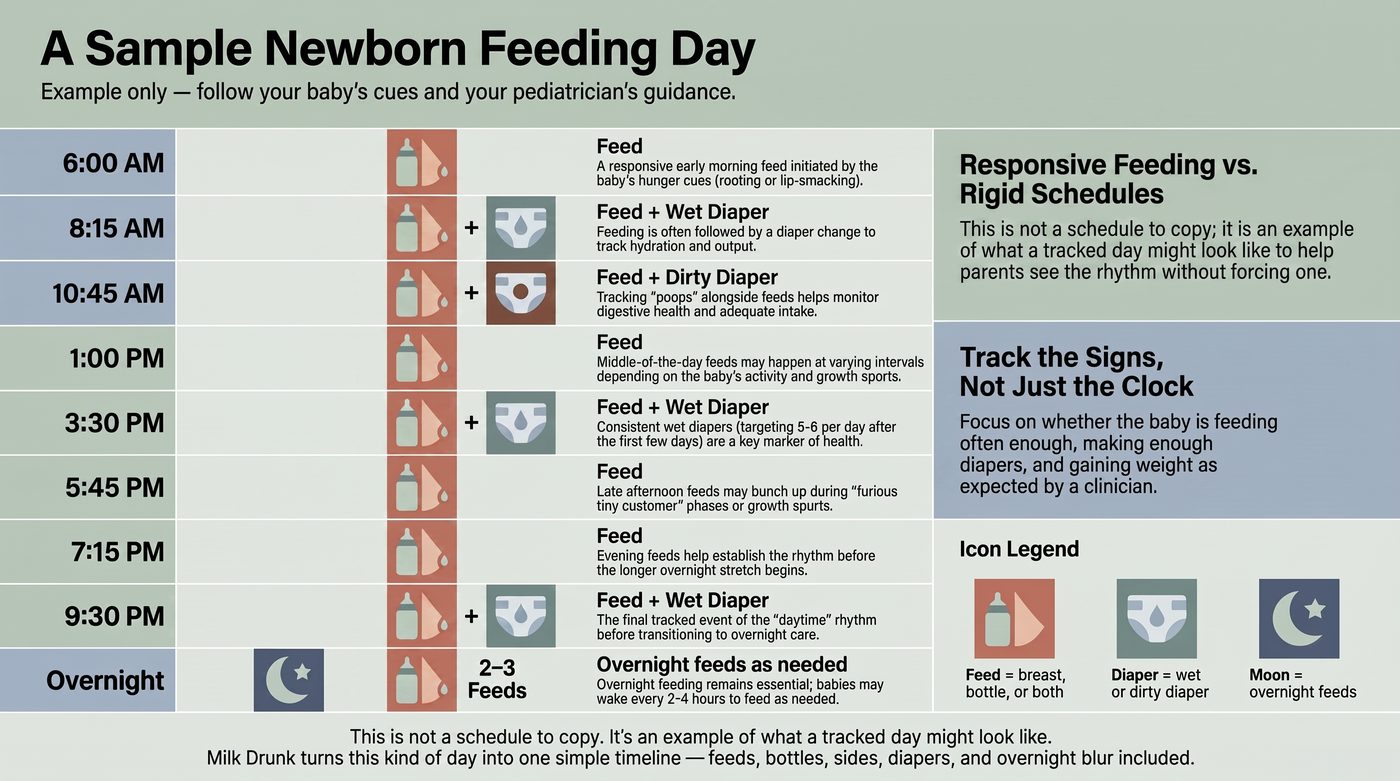
That kind of log is not about chasing perfection. It is about removing the mental math. If you have ever stared into the middle distance trying to remember whether the last feed was 40 minutes ago or three hours ago, you already understand the problem a tracker solves.
Doing feed math on broken sleep is not a fair fight. Milk Drunk logs feeds, sides, ounces, and diapers in one tap, on one clear timeline, so "when did she last eat?" always has an answer.
A note for each feeding method
If you are directly breastfeeding
Frequent feeding is normal, especially in the early weeks. What matters more than guessing ounces is swallowing, diaper output, and weight gain. The CDC says if you are worried, signs to watch include fewer than 8 sessions most days, trouble hearing or seeing swallowing, continued weight loss after day 5, or fewer than 6 pees per day by 5 days old.
If you are feeding expressed milk
Keep bottles responsive. The CDC says to offer small amounts, allow breaks, and stop when baby shows fullness cues, even if the bottle is not empty. If you are exclusively pumping or away from baby, pump as often as baby normally drinks. If milk is left in the bottle after a feeding, the CDC says to use it within 2 hours or discard it.
If you are formula feeding
The CDC says many newborns start at 1 to 2 ounces every 2 to 3 hours, then gradually take more as the weeks go on. Prepared formula should be used within 2 hours of preparation and within 1 hour from when feeding begins, and leftover formula from a used bottle should be thrown away.
If you are combination feeding
This counts as real feeding, not "doing it halfway." The NHS notes that many families combine breastfeeding with bottles of expressed milk or formula, and that gradual changes are easier on milk supply.
When to check in with pediatrics or lactation support
A schedule article should never pretend every problem can be solved by timing feeds better. Reach out if your baby seems too sleepy to feed, feeds very poorly, is still losing weight after day 5, is not back to birth weight on the expected timeline, has too few wet diapers, or you cannot hear or see swallowing with feeds.
And if your newborn regularly sleeps through long stretches without eating in these early weeks, ask your pediatrician what they want you to do. HealthyChildren.org advises not waiting too long between feeds if weight gain is a concern, even if that means waking your baby, and the CDC notes you may need to wake a sleepy newborn to feed, with gentle tricks like patting, stroking, undressing, or a diaper change.
A rhythm, not a routine
The goal here is not to create a perfect schedule. It is to have a realistic reference point, notice whether things are moving in the right direction, and stop carrying the whole feeding timeline around in your head.
So if you found yourself mentally calculating the last feed, the bottle ounces, and which side you used, that is exactly the friction Milk Drunk removes. One-tap timers. One timeline. Less guesswork. More "oh good, I do not have to remember that."
Frequently asked questions
How often should a newborn eat?
Most breastfed newborns eat 8 to 12 times in 24 hours, which can feel like every 1 to 3 hours in the early weeks. Formula-fed newborns commonly start at 1 to 2 ounces every 2 to 3 hours, with many also landing around 8 to 12 feeds a day. Frequent feeding is the norm, not a problem to fix.
What does a newborn feeding schedule look like in the first week?
Less like a schedule and more like a rhythm: small, frequent feeds around the clock while your baby's stomach is tiny and your milk or formula routine is getting established. The more useful first-week checklist is diaper counts building day by day and a baby who wakes and feeds with reasonable energy.
Should I wake my newborn to feed?
Sometimes, yes. In the early weeks, pediatric guidance leans toward not letting feeds slip too far apart, especially if weight gain is a concern. If your newborn regularly sleeps through long stretches without eating, ask your pediatrician what gap is acceptable for your baby, and use gentle wake-ups like undressing or a diaper change when needed.
How do I know my baby is getting enough?
Look at the pattern, not a single feed: frequent feeding, swallowing you can see or hear, a baby who seems content after at least some feeds, enough wet and dirty diapers for their age, and steady weight gain at checkups. If those are on track, an irregular-looking day is usually still a fine day.
Sources
- CDC: How Much and How Often to Breastfeed
- CDC: Newborn Breastfeeding Basics
- CDC: How Much and How Often to Feed Infant Formula
- CDC: Infant Formula Preparation and Storage
- CDC: About Feeding From a Bottle
- CDC: Pumping Breast Milk
- CDC: Signs Your Child Is Hungry or Full
- CDC: Breast Milk Storage Questions and Answers
- HealthyChildren.org (AAP): How Often and How Much Should Your Baby Eat?
- HealthyChildren.org (AAP): Your Baby's First Month: Growth & Physical Appearance
- NHS: Mixed feeding