


Newborn Sleep Schedule by Week: A Realistic Rhythm for the First Three Months
Newborn sleep has been sold to parents as either a beautiful little routine or a complete mystery. Annoyingly, it is often both.
The good news is that you do not need a perfect schedule right now. In fact, you are not really aiming for one. In the first weeks, the goal is a gentle rhythm: a loose sense of when your baby tends to wake, feed, nap, and settle again. That is a much better target than trying to force a tiny person with a tiny stomach and a very unfinished body clock into a polished bedtime routine. HealthyChildren.org, from the American Academy of Pediatrics, says babies do not have regular sleep cycles until about 4 months of age, and Children's Hospital of Philadelphia notes that newborns often have no set schedule at first and usually wake every few hours to feed.
This article is general information, not medical advice, and is not written or reviewed by a medical professional. It is not a substitute for professional medical care. Every baby is different, and Milk Drunk is not a medical device. Always consult your pediatrician or a qualified healthcare provider about your child's health, feeding, or care, and seek medical care right away if you are worried.
Weeks 0 to 2: Sleep is basically feeding with intermissions
In the first couple of weeks, many newborns sleep a lot overall but only in short stretches. Nationwide Children's says newborns sleep about 16 to 17 hours per day, but often not more than 1 to 2 hours at a time. Mayo Clinic similarly describes the first month as roughly 16 hours of sleep spaced around feedings, with babies often ready to sleep again after 1 to 2 hours awake.
Nobody is getting a lovely uninterrupted night here, and that is by design. Newborns have small stomachs, so feeding drives the rhythm: wake, eat, doze, repeat. Nemours KidsHealth notes that if your newborn sleeps longer stretches early on, you may need to wake them every 3 to 4 hours to eat until weight gain is well established, which usually happens within the first couple of weeks. Your pediatrician will tell you what they want for your baby.
What changes to expect in this window: not much "schedule," honestly. Day and night may feel completely mixed up. Wake windows are usually very short, often around 30 to 60 minutes from waking to sleepy again per Cleveland Clinic's wake-window guidance, and that time can disappear into one diaper change and one feed before your baby is ready to snooze. Sleepy cues matter more than the clock here: yawning, staring off, rubbing eyes, blinking more, or a general drop in activity are all common signs that the awake window is closing.
Weeks 3 to 6: A pattern may appear, but it is still a baby pattern
Around this stage, many parents feel like there is almost a rhythm. That is progress. Boston Children's notes that infants under 4 months often sleep 14 to 17 hours a day, and that younger babies commonly fall into a "cat nap schedule" with short rests roughly every 90 minutes or so. Some babies keep lots of short cat naps, and some begin to show slightly longer evening or overnight stretches.
Feeding still heavily shapes the day, which is why sleep and feeding are really one rhythm at this age; our newborn feeding schedule by week covers that half of the picture. Evenings can also bring a familiar fussy, snacky stretch where feeds bunch close together; that pattern has a name, and we cover it in our guide to cluster feeding.
The biggest changes to watch for are a slowly lengthening awake period and a stronger contrast between daytime and nighttime. HealthyChildren.org recommends light, normal household activity during the day and calmer, quieter care at night, because that contrast helps set the stage for a more settled day-night rhythm later. In plain English: daytime can feel like life, nighttime should feel like customer support in a dim lobby.
Weeks 7 to 12: Your first hints of bedtime
By this point, some babies begin to stay awake a little longer and sleep in slightly more organized stretches, even though newborn randomness is still very much invited to the party. BC Children's Hospital's sleep resource notes that sleep initially organizes around feeding times, with evidence of a circadian rhythm starting to emerge around 2 to 3 months. Nationwide Children's says most babies do not start sleeping a 6 to 8 hour stretch until about 3 months old, and plenty take longer. Wake windows often widen into the 1 to 2 hour range somewhere in the 1 to 3 month period.
This is usually the stage when "bedtime" starts to feel like a thing instead of a rumor. Not a fixed clock-time masterpiece, just a familiar evening sequence: feed, dim lights, swaddle or sleep sack if appropriate, bassinet, repeat tomorrow. Some naps may still be short. Some nights may still be chaos. Both can be normal. Regular infant sleep cycles are still developing, so progress should be measured in trends, not in one magical night.
What matters more than the clock
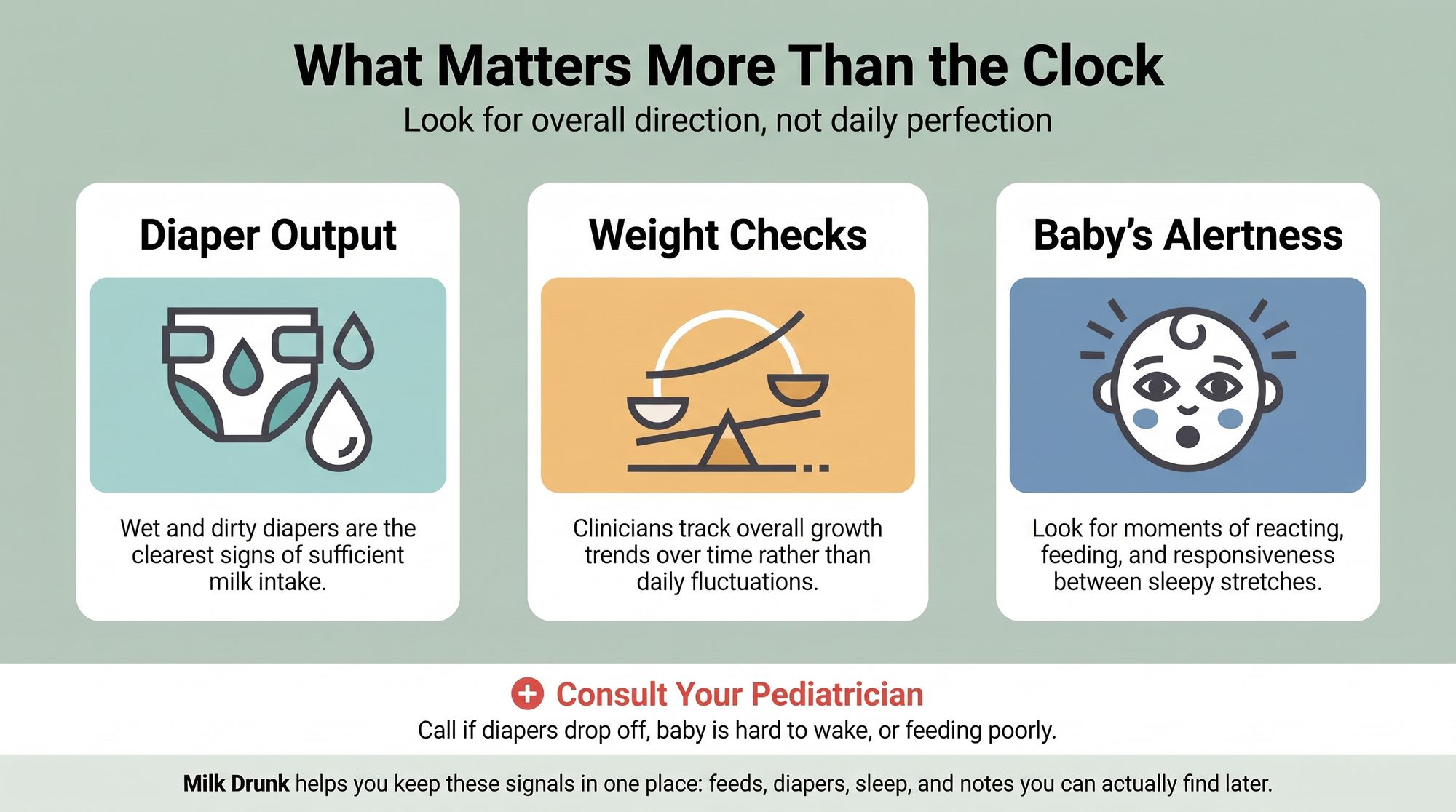
If you remember one thing from this article, make it this: in the newborn phase, the clock is useful, but it is not the boss. What matters more is whether your baby is feeding well, having appropriate diaper output, gaining weight appropriately, and having alert periods between feeds and naps. Sleep exists inside that bigger picture.
A baby who sleeps "well" but is too sleepy to feed well is not winning any medals. A baby who still wakes often but is feeding, growing, and gradually organizing their days is often doing exactly what babies do.
What not to optimize yet
You do not need to optimize every short nap. You do not need to force a rigid bedtime. You do not need to panic if your newborn wants to be awake at 1:17 AM and profoundly uninterested in your plans.
And unless your pediatrician has said otherwise, you should not assume night feeds are optional just because an influencer's baby allegedly sleeps 11 hours in a silk moon cradle. Newborns commonly wake every few hours to eat, many do not sleep a long overnight stretch until at least around 3 months or later, and more mature sleep cycles do not really show up until later infancy.
A very realistic chart for the first three months
Use this as a reference point, not a target to hit. The wake-window ranges are approximate, and the nap counts are editorial estimates based on total sleep, feeding-driven fragmentation, and pediatric wake-window guidance, not formal medical rules.
| Age range | Average wake window | Typical naps | What bedtime often looks like |
|---|---|---|---|
| 0 to 2 weeks | 30 to 60 minutes | Not really distinct naps yet; think many short sleep chunks across day and night | Bedtime is mostly "another sleep period after feeding" |
| 3 to 6 weeks | 45 to 75 minutes | Often around 5 to 6 daytime sleep chunks, but still highly variable | A familiar evening fussy period may show up; nights are still very feed-driven |
| 7 to 12 weeks | 60 to 120 minutes | Often around 4 to 5 naps, with one or two possibly getting longer | Bedtime may start to feel more recognizable, with one slightly longer first stretch for some babies |
Troubleshooting the classics
Day-night confusion
If your newborn seems fully committed to nocturnal socializing, you are not alone. This is common early on. The most practical approach is contrast: keep daytime bright and gently active, and keep nighttime care dim, quiet, and boring in the nicest possible way. HealthyChildren.org specifically recommends normal daytime light and noise, then nighttime interactions limited to feeding, burping, changing, and gentle soothing. No overnight fix exists, but the contrast usually helps within weeks.
Short naps
Short naps can feel like a personal insult when you finally sat down. But in the early months, they are often normal. Newborn sleep is fragmented, and younger babies commonly cat nap. If your baby is generally feeding well and the whole day is still adding up to a normal amount of sleep, a short nap is not automatically a problem to solve.
Only sleeps when held
This is common, and it makes sense. You are warm, loud in a familiar way, and frankly a better mattress than any bassinet has ever been. But safe sleep still matters every time. The AAP's safe sleep guidance is that babies sleep on their backs on a firm, flat surface with nothing loose in the sleep space, room-sharing rather than bed-sharing, and it warns that couches and armchairs are especially dangerous if an adult falls asleep while feeding or comforting a baby.
When you can, aim to transfer your baby to their bassinet or crib once they are drowsy. If you think you might doze off, especially on a couch or chair, move the baby to a safe sleep space first.
What is actually useful to track
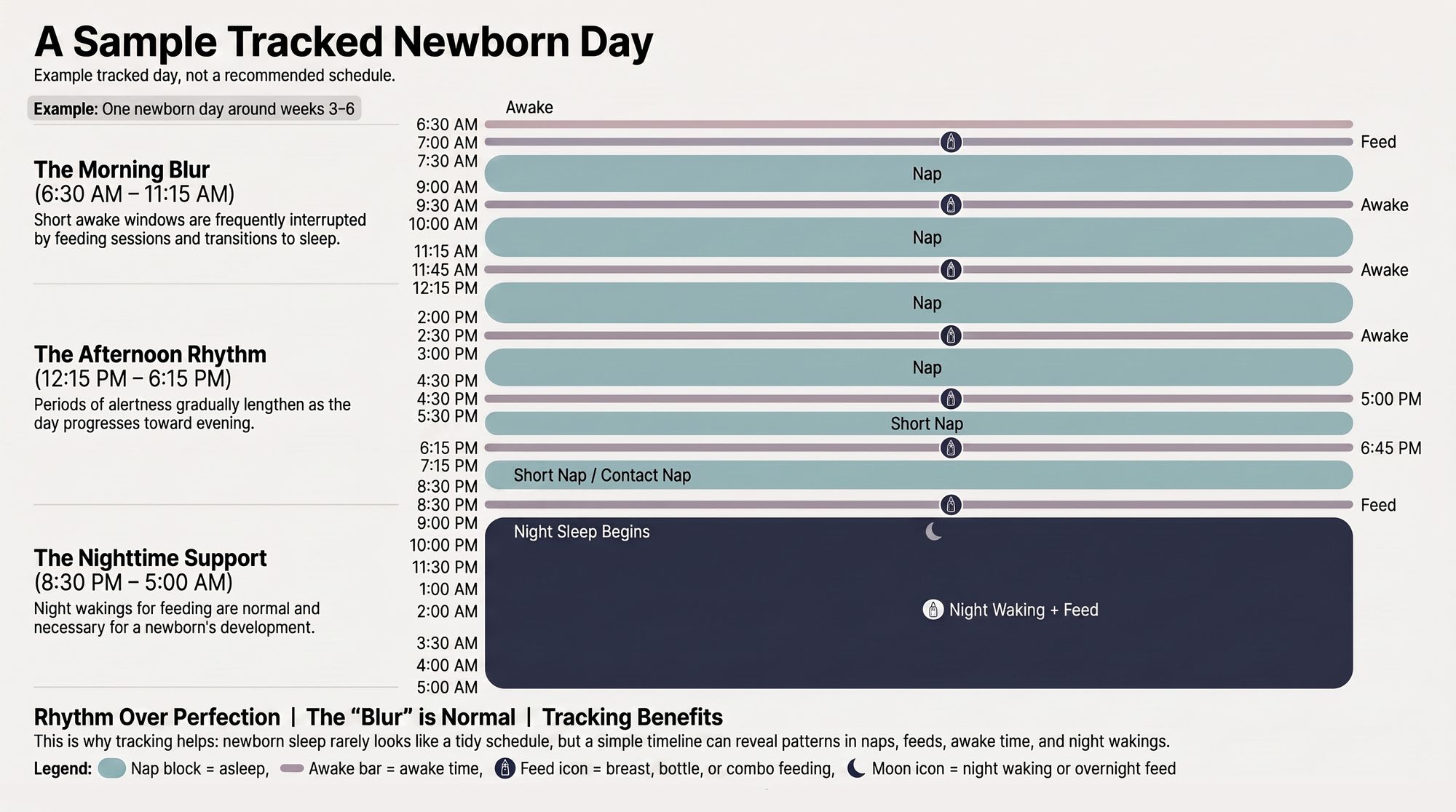
In this phase, you do not need a twelve-tab spreadsheet and a color-coded theory of naps. You need a short list that helps you see the pattern: the last nap, how long your baby has been awake, whether the nap was in the crib or a contact nap, and how often your baby wakes overnight. If feeds are closely tied to sleep, it also helps to know when the last feed happened.
That gives you enough context to spot whether the rhythm is gently improving, without turning your day into a data-entry internship.
Doing awake-time math at 4 AM is nobody's hobby. Milk Drunk runs a sleep timer in one tap and keeps naps, feeds, and night wakings on one timeline, so the pattern shows itself.
A rhythm, not a schedule
The goal of the first three months is not a perfect schedule. It is a rhythm you can see: awake windows that slowly stretch, nights that slowly consolidate, and a baby who is feeding, growing, and gradually figuring out which half of the day is which.
If you keep finding yourself mentally calculating the last nap, the current awake time, whether that was the contact nap or the stroller nap, and how many times everyone woke last night, that is exactly the kind of friction Milk Drunk is built to remove.
Frequently asked questions
How many hours do newborns sleep?
Commonly around 16 to 17 hours in 24, but in short stretches of 1 to 2 hours, and infants under 4 months often land anywhere in the 14 to 17 hour range. The total matters less than the pattern: lots of fragments early on is normal, not a problem to fix.
How long should a newborn stay awake between naps?
Wake windows are short: often 30 to 60 minutes in the first month, stretching toward 1 to 2 hours somewhere between month 1 and month 3. Watch your baby's sleepy cues (yawning, staring off, rubbing eyes, winding down) rather than the clock; the ranges are planning estimates, not rules.
When will my baby sleep a longer stretch at night?
Many babies manage their first 6 to 8 hour stretch around 3 months, some earlier, plenty later. Night feeds remain normal and necessary through the newborn phase, so measure progress in weekly trends, not in one magical night.
How do I fix day-night confusion?
Contrast, patience, and about two to four weeks. Keep days bright and normally noisy, keep nights dim and boring, and limit nighttime interactions to feeding, burping, changing, and gentle soothing. The body clock signals start emerging around 2 to 3 months, and the contrast helps them along.
Sources
- HealthyChildren.org (AAP): Getting Your Baby to Sleep
- HealthyChildren.org (AAP): Reversing Day-Night Reversal
- HealthyChildren.org (AAP): How to Keep Your Sleeping Baby Safe: AAP Policy Explained
- Cleveland Clinic: Wake Windows by Age
- Mayo Clinic: Baby naps: Daytime sleep tips
- Nationwide Children's: Infant Sleep
- Boston Children's: Sweet dreams: A guide to infant sleep
- BC Children's Hospital: Healthy Sleep for Kids: Newborns
- Nemours KidsHealth: Sleep and Your Newborn
- Children's Hospital of Philadelphia: Newborn Sleep Patterns